
Poland sits at the confluence of two major European drainage systems — the Vistula and the Oder — and the country holds several thousand lakes, most of them formed by glacial activity during the last ice age. This geography produces a wide variety of aquatic habitats: cold mountain streams in the Carpathians, warm shallow lowland lakes in Masuria, slow meandering rivers across the central plains, and large regulated reservoirs throughout.
The fish populations in these waters are just as varied. Below are the six species that account for the majority of angling effort in Poland, along with identification notes and the habitat conditions where each is most reliably found.
Common Carp (Cyprinus carpio)
Carp is the most widely distributed large fish in Polish lakes and slow rivers. The species tolerates oxygen-poor conditions better than most other fish and thrives in the warm, productive lowland waters of the Mazurian Lake District. Wild common carp reach weights of 10–15 kg in undisturbed waters; specimens over 20 kg are taken from larger reservoirs each year.
Identification is straightforward in adults: large scales, a rounded body profile, two pairs of barbels around the mouth, and a dorsal fin with a notably long base. The mirror carp variant has irregular, widely spaced scales along the lateral line and may appear almost scaleless on parts of the body.
The minimum legal size in most PZW districts is 30 cm. Carp have no closed season in Poland, though district water councils may impose local restrictions on specific lakes. Boilies, corn, and maize on a hair rig account for the majority of intentional captures.
Northern Pike (Esox lucius)

Pike occupies a position near the top of the food chain in most Polish freshwater systems. It is a solitary ambush predator that selects habitat based on available cover — reed beds, fallen trees, bridge pillars, and weed margins are all productive locations. Larger specimens tend to hold in deeper water during summer and move to the shallows in spring before spawning.
The species spawns early in the year, typically between February and April depending on water temperature. Polish fishing law prohibits targeting pike from 1 January to 30 April on most district waters, though the exact dates should always be confirmed with the local PZW office. The minimum legal size is 50 cm. Fish close to this threshold are frequently caught and should be returned promptly using wet hands to avoid damaging the protective mucus layer.
Lures account for most deliberate catches: large spinnerbaits, rubber shads, and jerkbaits all produce results. Live or dead bait fished under a float remains popular on still waters where casting range is not critical.
Brown Trout (Salmo trutta)
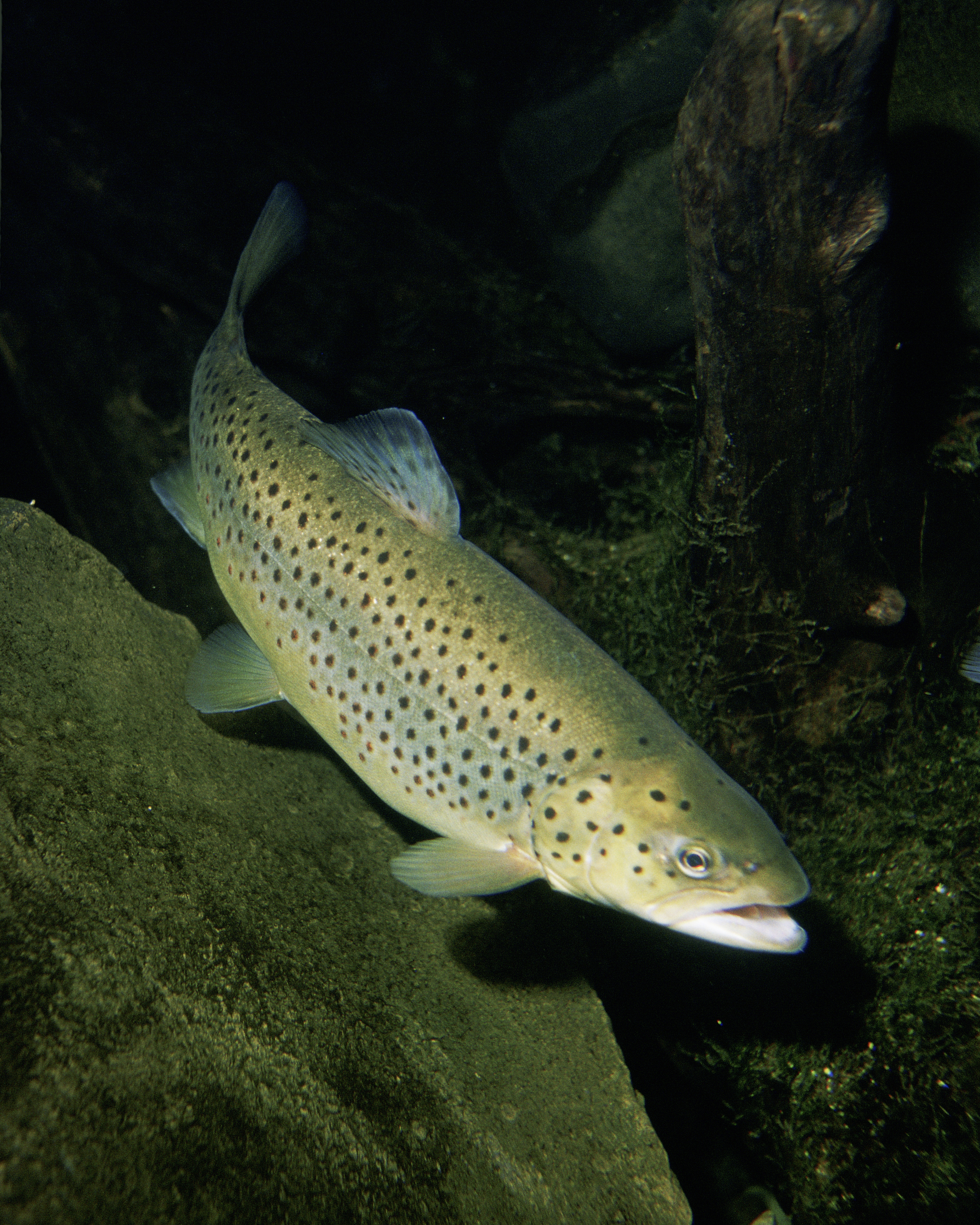
Brown trout requires cold, clean, well-oxygenated water and is therefore confined to upland rivers and a limited number of spring-fed lowland streams. In Poland, the most significant trout rivers are found in the Carpathian foothills: the Dunajec, Raba, Wisłoka, and their tributaries hold self-sustaining wild populations. The Sudeten rivers — Bóbr, Kwisa, and Nysa Łużycka — also support trout where river regulation has not eliminated suitable spawning gravel.
Identification in adult fish: olive to brown background colouring, red spots surrounded by pale halos along the flanks, and an orange or cream belly. Juvenile fish show parr marks — vertical bars along the lateral line — which fade as the fish mature. Confusion with rainbow trout (Oncorhynchus mykiss) is possible but rainbow trout typically shows a pink or red stripe along the lateral line rather than isolated red spots.
Trout fishing in Poland normally runs from May to the end of September. A district trout permit is required in addition to the standard PZW membership on almost all managed trout waters. Fly fishing is the most practised method, though worm and spinner fishing are permitted on many waters. Size limits commonly sit at 25–30 cm depending on the specific river.
European Perch (Perca fluviatilis)

Perch is arguably the most accessible species for anglers of all experience levels in Poland. It is present in nearly every lake, slow river, canal, and urban pond in the country. The species shows strong schooling behaviour when young, and juveniles provide rapid sport with light gear before dispersing into more solitary adult behaviour as they reach 200 g and above.
The distinctive colouring — dark green vertical bars against an olive-brown body, bright red-orange pectoral and pelvic fins, and a spined first dorsal fin — makes perch impossible to confuse with any other Polish freshwater species. The minimum size is 15 cm and there is no closed season, which makes it a target species throughout the year.
Small spinners (sizes 0–2), rubber grubs on a jig head, and worms under a float are all reliable. Perch often respond well immediately after a cold front when many other species go off the feed. In deeper lakes, vertical jigging with soft plastics accounts for fish throughout winter when ice conditions permit fishing from shore.
Tench (Tinca tinca)
Tench favours dense weed growth and soft bottom conditions — the reed-fringed edges of Mazurian lakes and the shallow bays of gravel pit waters are typical habitat. The species is tolerant of low oxygen levels and can survive conditions that would stress pike or perch. Adults are identifiable by their olive to bronze-green colouring, very small scales, and the single short barbel at each corner of the mouth.
Fishing for tench is generally most productive between May and August in the early morning before surface temperatures rise. The traditional approach is a simple float rig with worm or bread over a pre-baited area in 1–2 metres of water among patchy weed. Tench bites are characteristically slow — the float will often bob several times and lie flat before lifting away. The minimum size is 25 cm in most districts.
Common Bream (Abramis brama)
Bream is a shoal fish of open, productive water and is the dominant large species in many lowland Polish lakes where carp are not heavily stocked. Adults over 40 cm show the characteristic compressed, high-backed body profile and bronze colouring that distinguishes them from the smaller silver bream (Blicca bjoerkna).
Feeder fishing is the most effective technique for bream. A method feeder or cage feeder loaded with groundbait is cast to a marked spot and the line fished tight. Bream shoals can be held in a swim for hours with regular rebaiting. Sweet corn, worm, and red maggots are all productive baits. The minimum size is 25 cm; bream have no closed season in Poland.
Habitat notes for planning a session
Polish fish are not evenly distributed across water bodies. Water temperature, oxygen concentration, and available food are the primary drivers of where fish hold at any given time. In summer, carp and tench concentrate near weed beds in the morning and move off into deeper, cooler water by mid-afternoon. Pike follow prey fish, and their position is often predictable by locating dense roach or bream shoals. Trout hold behind current breaks in rivers — boulders, bends, and fallen trees — where food drifts past with minimal energy expenditure required.
For up-to-date species distribution data and stocking reports on specific lake districts, the Polski Związek Wędkarski maintains regional fisheries databases updated annually. The FishBase global database provides detailed life history parameters for all species mentioned above.